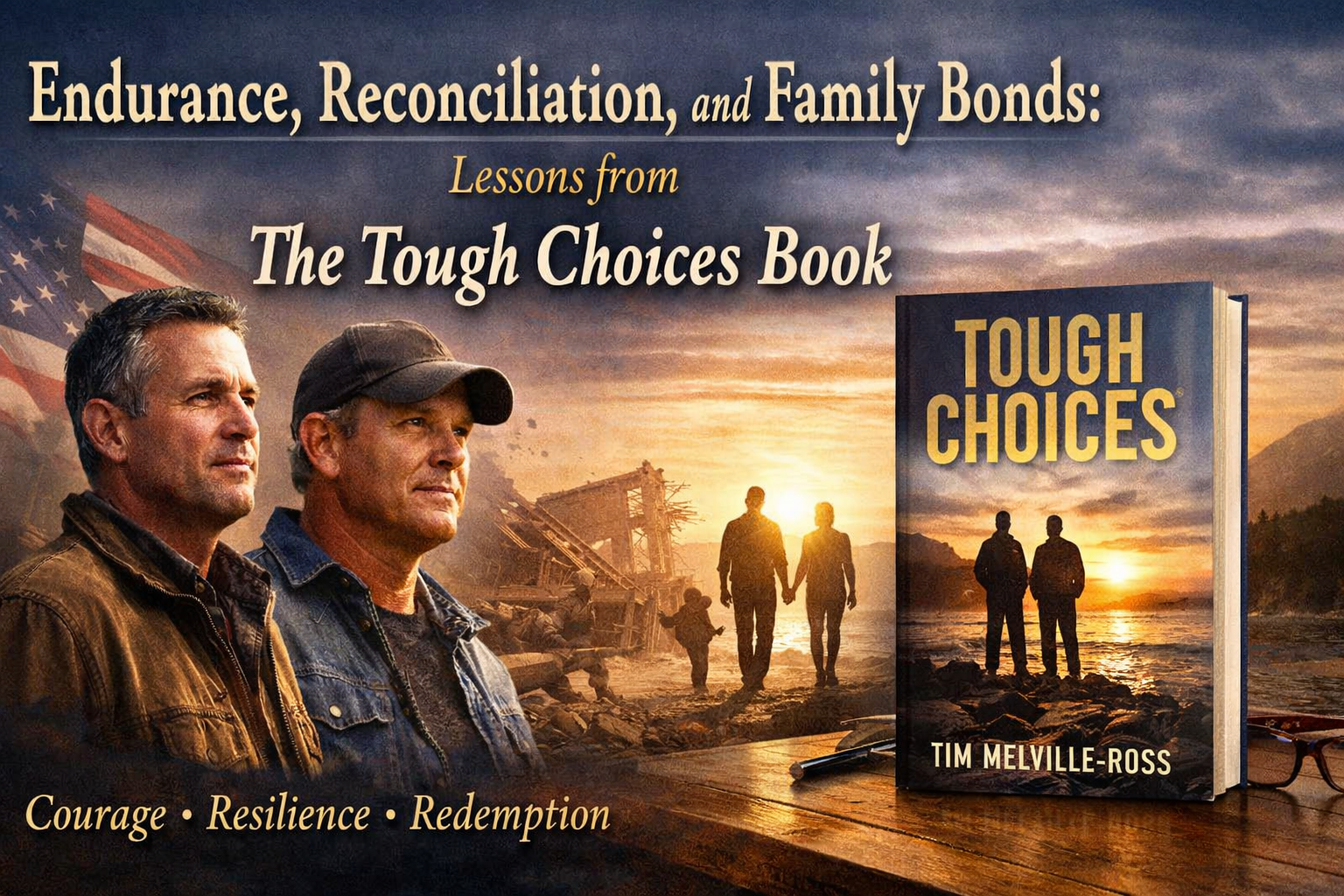
The Tough Choices book by Tim Melville Ross highlights the journeys of Tod and Scott Peterson as they face adversity, family struggles, and personal growth across decades. The book explores courage, vulnerability, and dignity. The book focuses on the importance of getting back on your feet after setbacks and the learning that comes with that process.
The Tough Choices book weaves together their experiences with major historical events and explores themes of endurance, reconciliation, and the power of family bonds. The book’s central themes of influence and the search for meaning and redemption are central throughout. Tod examines, like no other, the arduous journey of facing life’s greatest catastrophes with courage and resilience, whether it’s the end of a relationship or a collapse. It’s a path that involves connecting with fear and pain. Because only during the process of getting back on our feet will we discover all the good we have within us.
Turning Fear Into Power
The Tough Choices book moves you on every page. Ross discusses the possibility of turning fear into an instrument for change. Why is it so difficult to make important decisions?
- The fear of making mistakes: This fear leads us to consider too many scenarios, and the sheer number of scenarios we consider can mentally paralyse us. Furthermore, the uncertainty surrounding what will happen generates stress that does little to help.
- The weight of responsibilities: In this sense, the potential consequences of our decisions can increase the pressure and fear of making mistakes. Depending on the issue at hand, we will have certain responsibilities and, of course, certain consequences associated with our choices.
- The importance of this issue: It’s common to postpone difficult decisions, but we must recognise that we will likely face these problems sooner or later. Therefore, let’s learn to manage these decision-making processes to improve our overall well-being and quality of life.
What is emotional blockage when making decisions, and how can we detect it? Definition of “emotional blockage”: Emotional blockage occurs when we feel emotionally overwhelmed by a situation that has caused us distress or stress we don’t know how to cope with, and our brain resorts to blocking because it feels saturated.
Most common symptoms: Procrastination, anxiety, mental saturation.
Among the most common symptoms, we find procrastination, which means we keep postponing or delaying what we know we have to do. We also experience anxiety, meaning we feel anxious because this blockage paralyses us, and we don’t know what to do. Finally, we experience mental saturation, caused by the uncomfortable feeling of being mentally blocked, in a seemingly endless cycle. We become saturated because we are blocked, and being blocked only exacerbates the mental saturation.
- Self-criticism and perfectionism: When we are so harsh and rigid with ourselves, we notice how difficult it is to make difficult decisions because this self-criticism and perfectionism overwhelm us. We demand too much of ourselves, we are not being fair to ourselves, and we are demanding perfection.
- Information overload: Sometimes, having so much data, instead of helping us, overwhelms us. This can be because when we have so much information, we tend to analyse each aspect to the point of exhaustion, which is of little help.
- Insecurity and low self-esteem: When we are insecure and low on self-esteem, we overanalyse everything, see ourselves as weak and inferior to others, and, no matter what we do, think others are the ones who really know how to do things. As you can see, these two elements will affect our confidence when making decisions.
- Fear of what others will say: Often, when making difficult decisions, we tend to give too much importance to social and family pressure and to the need for approval, which greatly conditions us when it comes to choosing freely and what we truly want.
The Tough Choices book teaches us to overcome the fear of making mistakes and make decisions with confidence:
- Clarify objectives and priorities: It is very important to know what we really want before making a choice. We know that sometimes having this clear will be difficult, but many times in life we will have to choose between several options.
- Pros and cons method: If we want it to be clearer visually, let’s use a sheet of paper to write down the pros and cons of each decision, as a way to objectively evaluate each option.
- Visualisation technique: Let’s imagine future scenarios to reduce uncertainty. Visualising possible scenarios to see how we can deal with them.
- Incorporating intuition: While it’s good to be guided by your heart, let’s never forget our dear friend, the brain. Let’s try to reach a consensus decision, one we’re comfortable with, combining reason and emotion as much as possible.
Strategies in Tough Choices book for controlling emotions during the decision-making process:

- Conscious breathing and mindfulness: Reducing anxiety in stressful moments. Although it’s difficult at first, let’s try to control our breathing to reduce anxiety in those stressful moments.
- Self-empathy and positive self-talk: Here, it will be very important to be empathetic with ourselves as we experience this situation.
Why does surrounding ourselves with people who love us teach us to love ourselves more and better?
The Tough Choices book discusses how the inevitable hardships of life can make us increasingly cowardly and bitter, or, conversely, can be a source of inner strength. These simple teachings, directly applicable to daily life, provide us with the mental tools necessary to transform our fears, anxieties, and frustrations into wisdom and courage.
Transforming Hardship Into Strength
This Tough Choices book also confers how nothing external to us has the power to steal our peace of heart and mind. We may not have total control over what happens in our lives, but we are certainly the ones who decide how we want to perceive our experience.
Experiencing inner peace and well-being doesn’t mean our lives will always be blissful, but we can connect with that state amidst chaos. The first step to experiencing it is to silence the useless mental chatter or the storyteller of our dominant mind and choose the will to be present in the here and now.
Ready to be inspired and empowered to make your own tough choices? Start your journey today by reading this transformative Tough Choices book!